
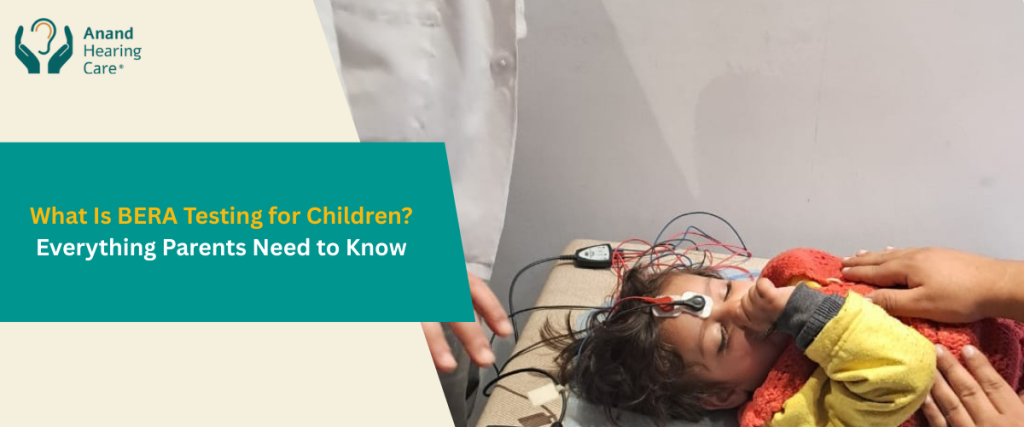
BERA testing is a safe and reliable hearing test for babies and young children who cannot clearly tell us what they hear. It checks how sound signals travel from the ear to the hearing nerve and up to the brainstem using small sensors placed gently on the skin.
Since the child does not need to speak, raise a hand, or follow instructions, the results are accurate and trusted by doctors. BERA is often suggested for children with speech delay, poor response to sounds, or medical risk factors like premature birth or NICU history. Early testing helps parents take the right next step quickly.
What is a BERA / ABR Test?
BERA (Brainstem Evoked Response Audiometry) and ABR (Auditory Brainstem Response). Both names refer to the same type of test that checks how your child’s hearing nerve and brain pathways respond to sound.
During the test, soft clicking sounds are played through earphones. Tiny sensors (electrodes) placed on the head and near the ears record the brain’s response to those sounds. This is why BERA/ABR is called an objective hearing test – it measures automatic nerve signals, not your child’s reactions like pointing, speaking, or raising a hand.
Who Should Get a BERA Test?
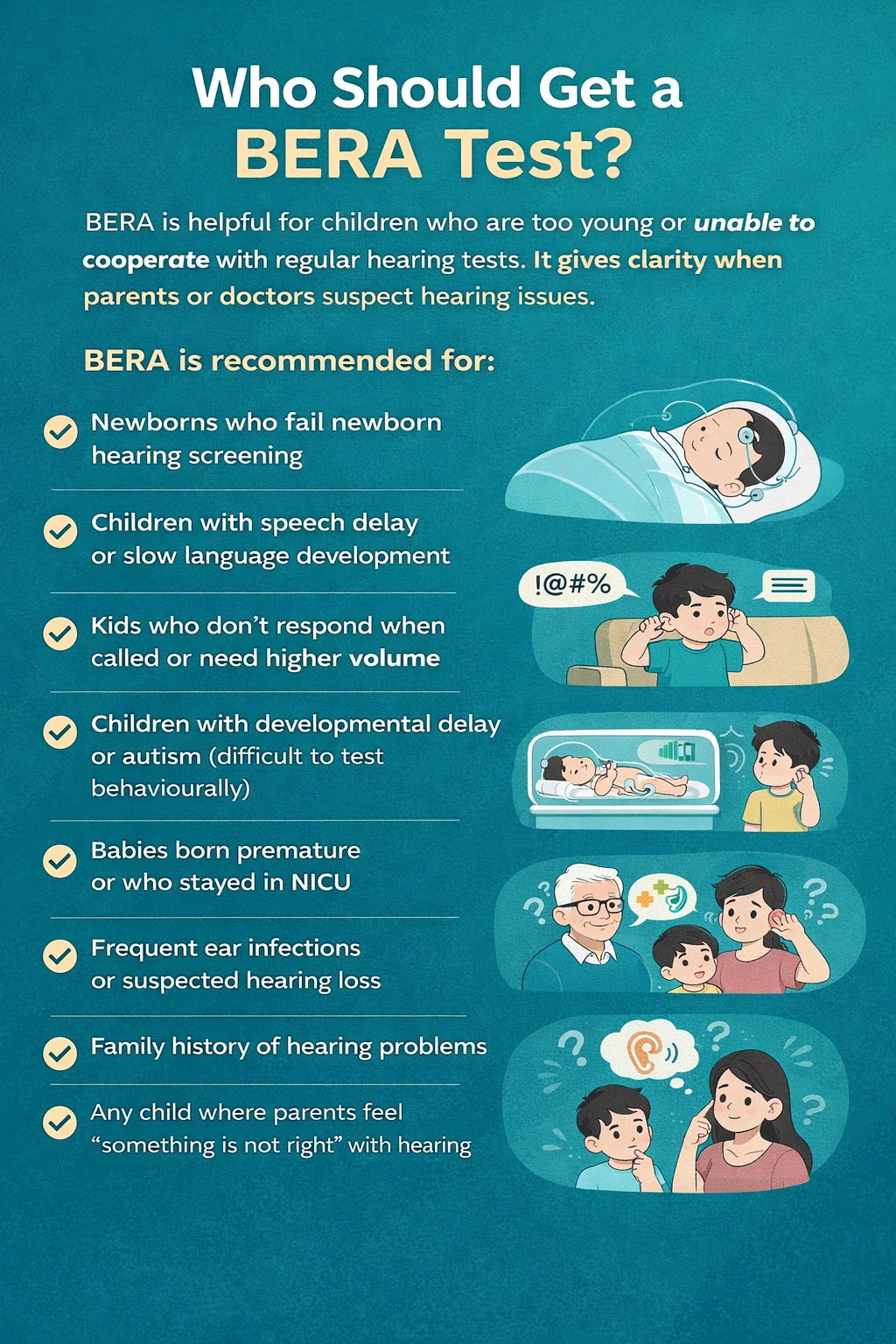
BERA is helpful for children who are too young or unable to cooperate with regular hearing tests. It gives clarity when parents or doctors suspect hearing issues.
BERA is recommended for:
- Newborns who fail newborn hearing screening – BERA confirms if hearing loss is present and how serious it may be.
- Children with speech delay or slow language development – Hearing issues are often the hidden reason a child isn’t speaking on time.
- Kids who don’t respond when called or need higher volume – Poor response to name calls or loud TV volume can signal hearing difficulty.
- Children with developmental delay or autism – BERA works well because it doesn’t require the child to respond or cooperate actively.
- Babies born premature or who stayed in NICU – These babies have a higher hearing risk due to early medical complications.
- Frequent ear infections or suspected hearing loss – Repeated infections or ear fluid can block sound and reduce hearing levels.
- Family history of hearing problems – Genetic factors can increase risk, so early testing is important.
- When parents feel “something is not right” with hearing – if your child seems unaware of sounds, BERA helps confirm the cause clearly.
Why is BERA Testing Important for Children?
Hearing problems in early childhood can affect speech, learning, and confidence. BERA helps detect hearing loss early, even before the child starts talking properly.
Why it matters:
- Early detection supports better speech development
- Helps avoid learning and attention issues in school
- Useful when the child cannot explain hearing problems
- Gives accurate results without “guessing”
- Helps doctors decide the right treatment faster
- Can detect nerve-related hearing issues
- Builds a clear plan for hearing aids or therapy if needed
How BERA Testing is Done?
BERA testing is done in a quiet room, usually when the child is sleeping or resting. Small sensors are gently placed on the forehead and behind the ears, and earphones deliver soft sounds.
The machine records how the hearing nerve and brainstem respond to those sounds. Since your child doesn’t need to answer or perform any task, the test stays smooth. The most important part is that the child remains calm or asleep to avoid movement, which can disturb the readings.
Step-by-Step BERA Test Procedure
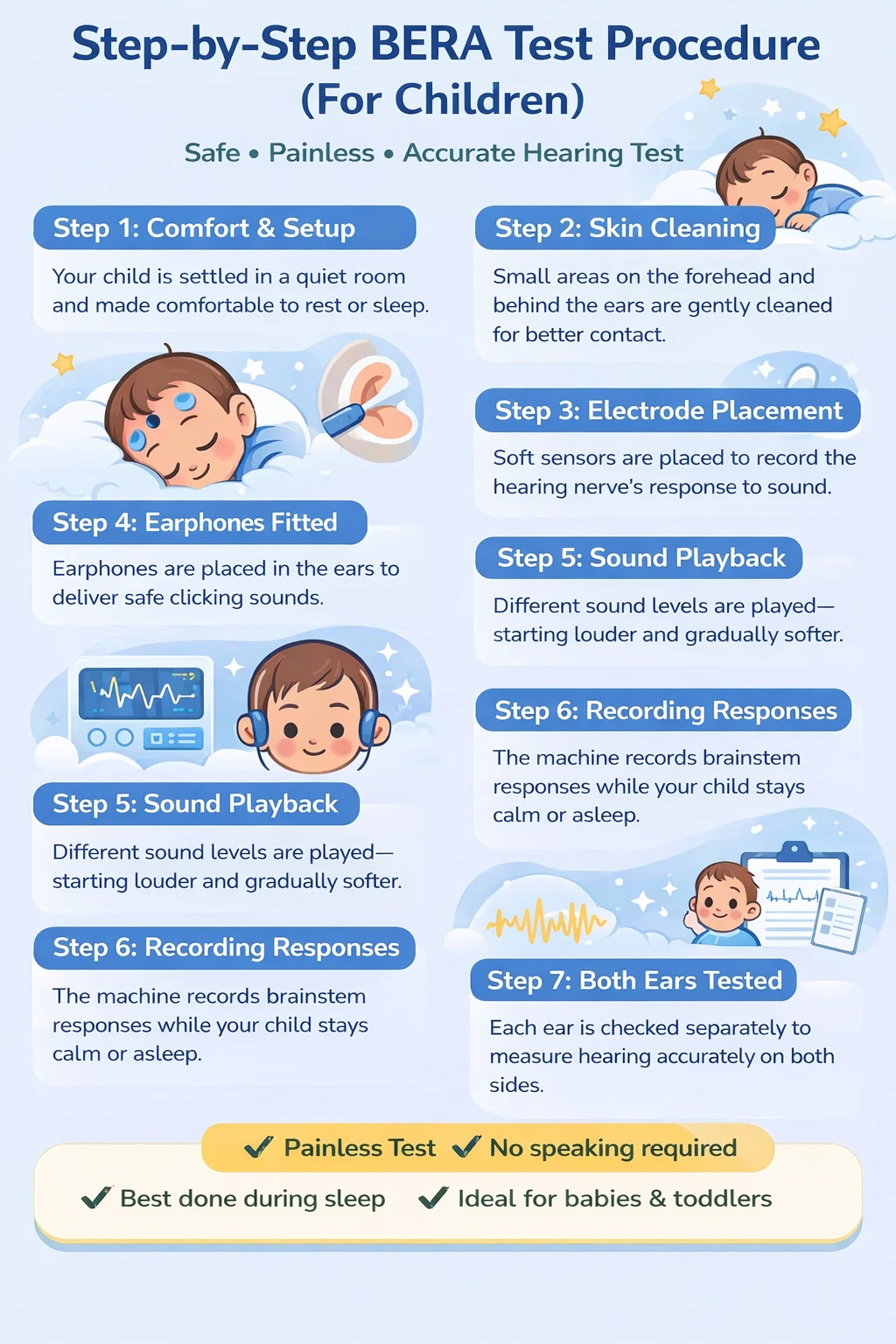
BERA testing follows a simple, safe process to check how your child’s hearing nerve responds to sound. Since the test works best when the child is calm or asleep, the entire procedure is planned to be comfortable and stress-free for both the child and parents.
Step 1: Comfort & Setup: Your child is made comfortable in a quiet room and encouraged to rest or sleep for accurate results.
Step 2: Skin Cleaning: Small areas on the forehead and behind the ears are gently cleaned for better electrode contact.
Step 3: Electrode Placement: Soft, sticky sensors are placed on the forehead and near the ears to record hearing nerve responses.
Step 4: Earphones Fitted: Earphones are placed to deliver safe clicking sounds into each ear.
Step 5: Sound Playback & Recording: Different sound levels are played and the machine records how the brainstem responds.
Step 6: Both Ears Tested: Each ear is tested separately to measure hearing clearly on both sides.
Step 7: Wave Analysis: The audiologist checks response waves on the system to estimate hearing levels.
Step 8: Report & Guidance: A detailed report is prepared and explained to parents with the next recommended steps.
How to Prepare Your Child for a BERA Test?
A little preparation makes the test faster and more accurate, especially for babies and toddlers.
Helpful preparation tips:
- Keep your child sleepy (avoid long naps before the test)
- Feed your baby just before the test to help them sleep
- Bring a blanket, pacifier, or favourite toy
- Dress your child in comfortable clothes
- Wash hair and avoid oil/cream on the scalp
- Inform the clinic if your child has a cold or a fever
- Carry previous hearing reports if available
- Reach early so your child settles calmly
Understanding BERA Test Results-
BERA results look like wave lines on a report, but don’t worry—your audiologist will explain everything in simple terms.
What the report can tell you:
- Whether hearing pathways are responding normally
- Approximate hearing level in each ear
- If hearing is normal, mild, moderate, severe, or profound loss
- Whether one ear is weaker than the other
- If responses are delayed (possible nerve pathway issue)
- If further tests like OAE/tympanometry are needed
- If hearing aids may help, and when to start
- If an ENT consultation is required for medical treatment
Cost of BERA Testing
The cost of a BERA test in India generally falls around ₹3,500 to ₹6,500, though the exact price can vary based on the clinic, city, and testing setup. Charges may be slightly higher if the test includes a consultation, detailed report, or is combined with other assessments like OAE for a more complete hearing evaluation. In some cases, young children may need natural sleep testing or mild sedation, which can further influence the final cost.

Why Choose Anand Hearing Care for BERA Testing for Children?
At Anand Hearing Care, we make BERA testing comfortable, accurate, and stress-free for children and parents. Our team focuses on gentle handling, reliable test reporting, and clear next-step guidance so you know exactly what to do after the test—without confusion or fear.
✅ Child-Centric Testing Approach
Children get anxious easily, so we keep the process calm and friendly. We give your child time to settle, avoid rushing, and ensure they feel safe. This improves cooperation, reduces stress, and also helps us capture clearer test results.
✅ Advanced BERA Diagnostic Technology
We utilise modern BERA/ABR equipment, designed to capture accurate hearing responses, even in small babies. Better technology means fewer errors, clearer wave readings, and more dependable results—especially when early diagnosis is critical.
✅ Specialized Pediatric Audiology Expertise
Our audiologists are experienced in testing infants and young children. Pediatric testing needs extra care and knowledge. From proper electrode placement to correct interpretation, we ensure results match your child’s real hearing condition and needs.
✅ Safe, Calm & Parent-Friendly Environment
Our clinic setup is peaceful and child-comfort oriented. Parents can stay close, and we explain each step clearly. This makes the visit smoother and helps children stay relaxed—because a calm child means a more accurate test.
✅ Post-Test Guidance & Next Steps
After the test, we don’t just hand over the report. We explain what it means, what level of hearing is present, and what to do next—whether it’s hearing aids, ENT treatment, therapy, or follow-up testing.
 |
 |
Conclusion
BERA (ABR) testing is one of the most reliable hearing tests for babies and young children. It checks how sound messages travel from the ear to the brain, without needing the child to speak or respond. This makes it ideal for newborns, toddlers, and children with speech delay. Early diagnosis matters because hearing affects speech, learning, and overall development. If any doubt exists about your child’s hearing, BERA testing gives clarity and helps you take the right next step quickly. The sooner hearing problems are found, the better the outcome for the child.
Frequently Asked Questions
1) Is the BERA test painful?
No, it’s completely painless. Sensors are pasted on the skin, and your child only hears soft sounds through earphones.
2) Can BERA testing be done on newborns?
Yes. BERA is commonly done for newborns, especially if they fail initial screening or have a NICU/high-risk history.
3) How long does the test take?
Usually 45 to 90 minutes. It can take longer if the child wakes up often or moves a lot.
4) Is sedation always required?
No. Many babies can be tested during natural sleep. Sedation is only used when the child cannot stay calm or asleep.
5) What are the next steps after the test?
Based on results, the audiologist may suggest hearing aids, ENT consultation, speech therapy, or follow-up tests to confirm and plan treatment.
6) Are BERA and ABR the same hearing test?
Yes. BERA and ABR are the same test—an objective, non-invasive method that measures auditory nerve and brainstem response to sound using electrodes, used for all ages.